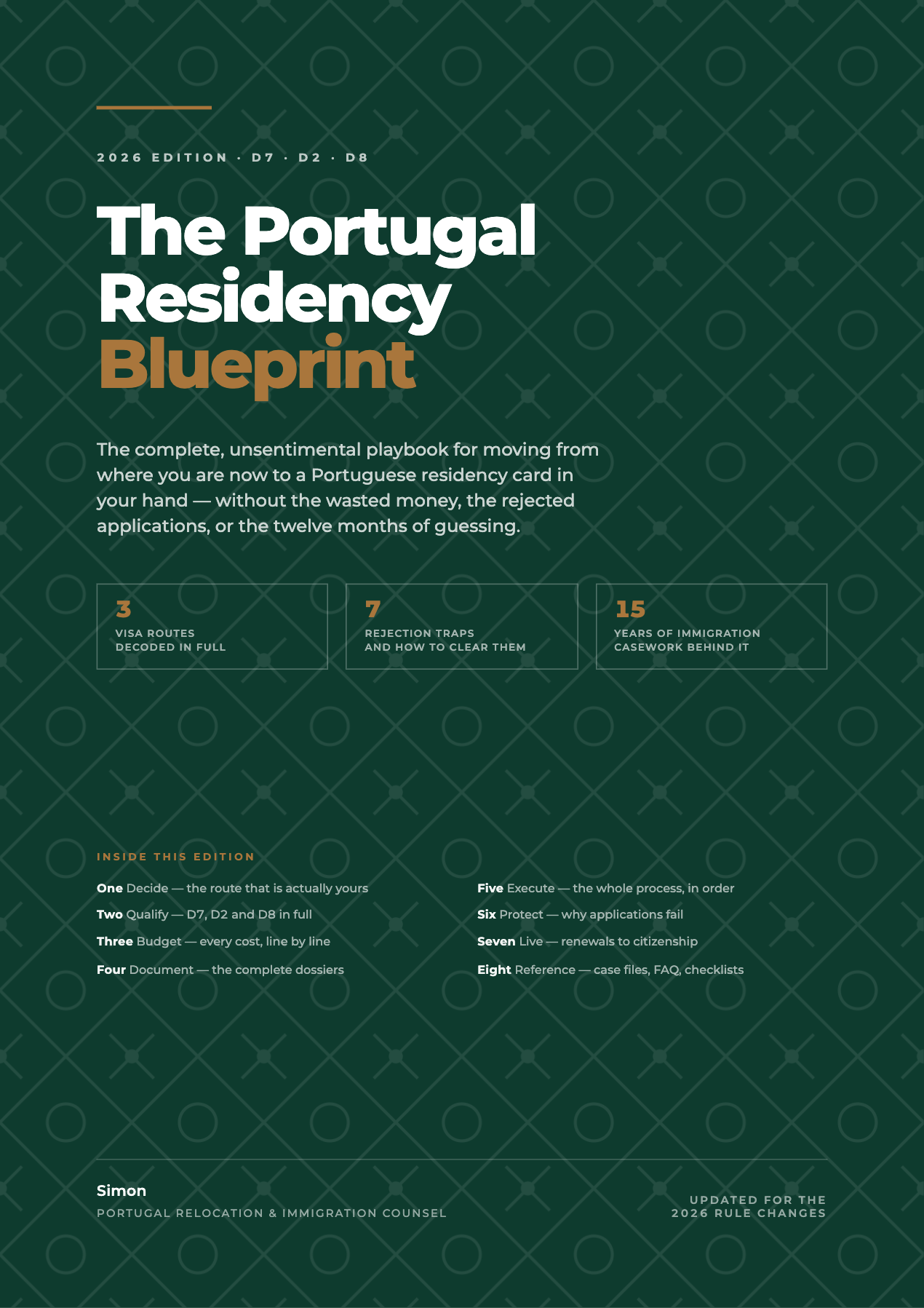
For anyone relocating to Portugal in 2026 — D7 · D2 · D8
From “I want to move to Portugal” to a
residency card in your hand — without the
rejected application, or the thousands you never needed to spend.
Every threshold, every document, every cost, every deadline, and all
seven reasons applications get refused — written by an
immigration counsel who has personally held residence permits in five
countries, and is going through Portuguese residency himself for the
fifth time.
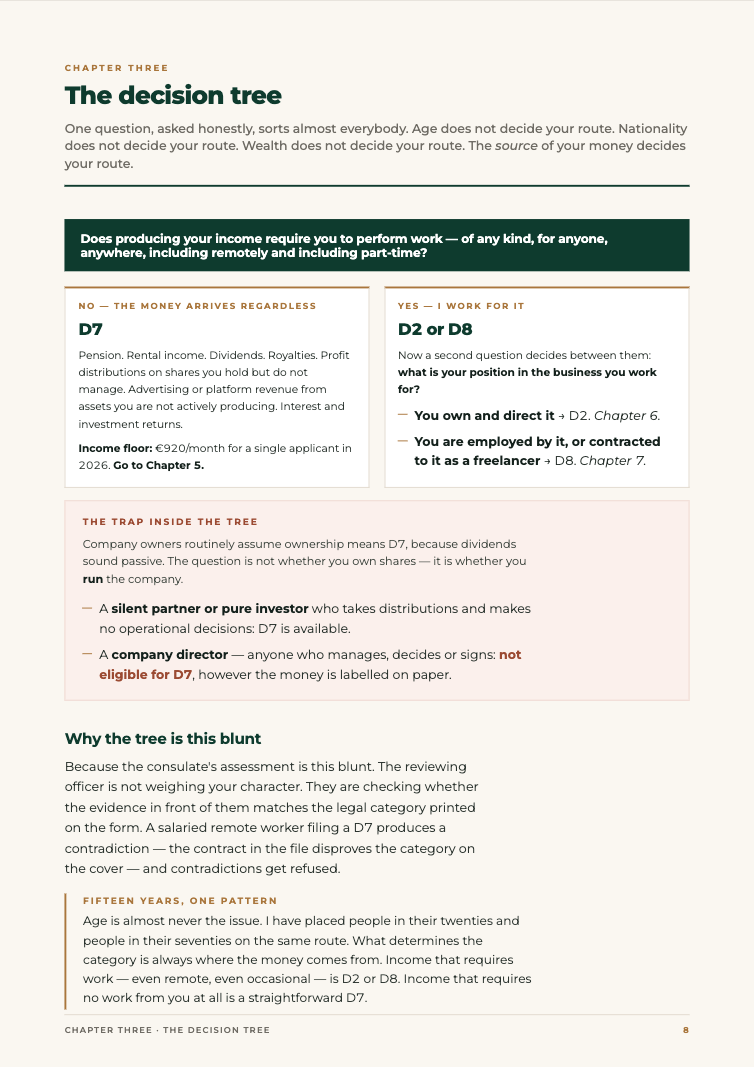
The one question that decides whether you are D7, D2 or D8 — and why most people get it wrong
The exact 2026 income floors, with the formulas behind them so they stay right next January
The complete document dossier for each route — and the order to collect them in
The €360 mistake that causes a top-three share of all refusals
One payment. Yours forever.
Updated for the 2026 rule changes.
41Pages
€920The 2026 monthly income floor for a single D7 applicant — the lowest in western Europe
25Chapters covering every stage, from choosing a route to citizenship
7Refusal reasons, named — and how to clear every one of them
15 yrsOf immigration casework behind every number in the book
What this is actually about
Nobody wants a residency permit. They want the life on the other side of it.
Between the two sits a pile of paperwork that most people get wrong at
least once. This book is about getting through it in a single pass.
Story one
The letter is one page long. It takes about nine seconds to read, and it undoes fourteen months.
I have read a lot of these letters. Here is the part that still gets me:
the people who receive them are almost never the people who were
unqualified.
Picture a man in his early fifties. A dentist, as it happens. Thirty years
of drilling and filling and a savings account that reflects it. He has
decided — properly decided, not idly wondered — that he is
going to stop, and that he is going to stop in Portugal.
So he does what you would do. He reads. Fifty forum threads. A dozen blog
posts. Four Facebook groups where everybody is confident and nobody
agrees. He pieces together something that looks like a plan out of
fragments written by strangers, most of whom have been through exactly one
application, and none of whom have been through his.
Somewhere in that reading he picks up a sentence. It is a sentence you have
probably read yourself, because it is everywhere:
“Anyone who works remotely can apply for a D8.”
Completely deceiving — and repeated everywhere
It is said in good faith, constantly, by people who have never filed an
application. And it is wrong in a way that costs money. The D8 requires a
remote work contract and income above
four times the Portuguese minimum wage. Working remotely
is not the qualification. The contract is.
Our dentist does not have a contract. He has not had an employer in
decades. What he has is better than a contract — savings and income
that require no work from him at all, which is the single strongest
position from which to apply for Portuguese residency. But he does not
know that yet. Nobody has told him. So he builds his plan on a sentence he
read on the internet.
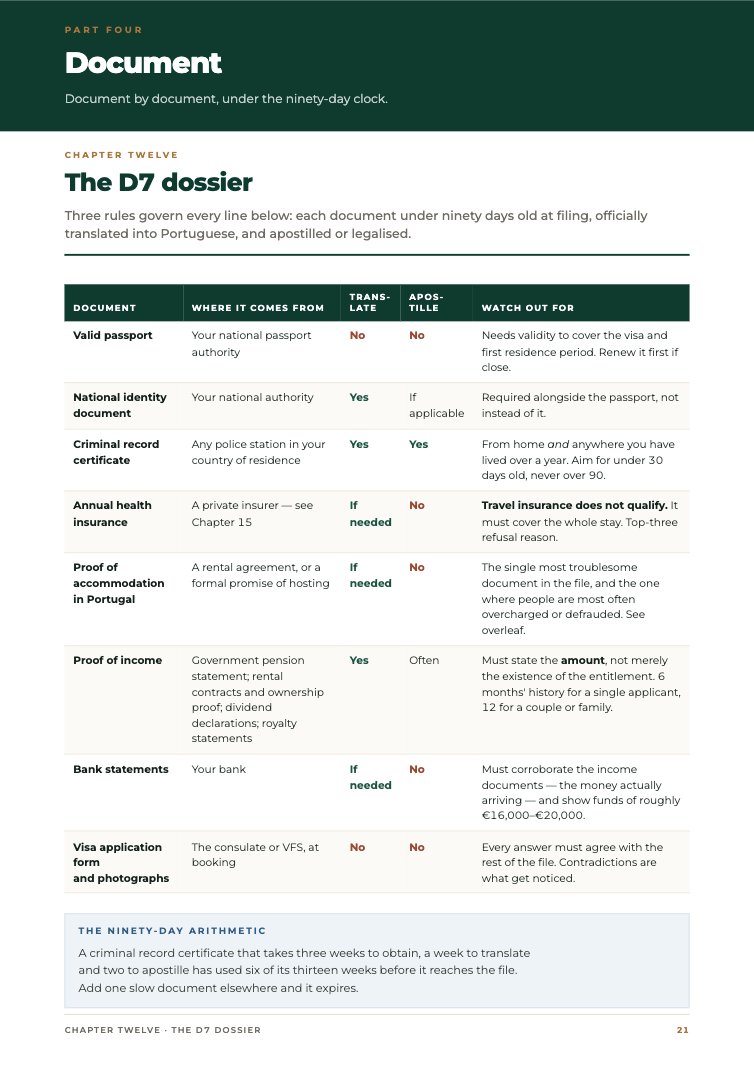
The whole application, laid out. Every document here has a source, a
validity window and a translation requirement — and getting any one
of them in the wrong order is what turns fourteen months into a refusal.
Month two
Next he panics about housing, because housing is the part that feels real.
Documents are abstract. An apartment is a thing. So he finds a flat in a
city he has never set foot in, and he wires a deposit.
This is the largest single discretionary cost in the whole process
— somewhere between €2,000 and €6,000
depending on location and size — and he has just committed it before
establishing which visa he is applying for, before obtaining the tax
number that makes a lease workable, and before visiting the country. If
his category turns out to be wrong, that money does not come back. If the
city turns out to be wrong, it also does not come back.
Months three to seven
Then he starts gathering documents. In the wrong order, because nobody told
him there was an order. He does the easy ones first, which is the natural
human instinct and precisely backwards.
Criminal record certificates are the slowest item in any file. They have
to come from his home country and from every country he has lived
in for more than a year. They need apostilles. They need certified
translation into Portuguese. Each of those steps takes weeks and costs
€50 to €200 per document.
He starts those last. And by the time the final certificate arrives, the
first documents he collected have expired, because
everything in a Portuguese visa file must be under ninety days
old on the day you submit it. Nobody mentioned that either. So he
pays to get them again.
Month nine
He finds an appointment slot — one to three months of checking a
booking site daily, which is its own quiet education — and he
submits. There is no interview. He hands over a folder, gives his
fingerprints, and goes home to wait.
Month eleven
And then the letter.
You are refused
Not because he could not afford to live in Portugal — he could
afford it several times over. Not because he was unsuitable. But because
he applied under the wrong article of Portuguese law, and because the
insurance policy in his file covered ninety days when the embassy
required an annual health policy covering his whole stay.
Two mistakes. Both free to avoid. Neither of them anything whatsoever to
do with whether he qualified.
Add it up and that route costs people somewhere between four and ten
thousand euros and most of a year. And it does not end at zero. It ends
below zero, because there is now a refusal on the record, and
every subsequent application he files will be read in the light of it.
I want to be precise about the thing that bothers me here. The Portuguese
system did not screen him out. It screened out a badly assembled file. The
man was always going to be approved. The paperwork was not.
Two routes to the same card
There are two ways to get Portuguese residency. Almost everybody picks the expensive one by accident.
Not because they are careless. Because the cheap way requires knowing
things in a specific order, and nobody hands you that order.
The way most people do it
Four to ten thousand euros · eleven to fourteen months
Pick a visa category from a forum sentence that sounded like it applied to you
Commit to accommodation first, because it feels like the real decision
Collect documents easiest-first, and watch the early ones expire
Buy travel insurance, because the visa is only 120 days
Spend the savings on flights and deposits before the card is issued
Discover AIMA re-examines everything, months later, inside Portugal
File, wait, and read a one-page letter
Start again from a weaker position, with a refusal on the record
Ends with: a refusal, and the process to do over
The way that works
Around €6,000 all-in · six to twelve months
Establish which legal category your income actually puts you in — not the one you like the sound of
Obtain the tax number first, remotely, because it unblocks everything else
Map the document timeline backwards from your filing date, slowest items first
Buy annual private health insurance, which is what the embassy actually requires
Commit to accommodation only after the category and the timeline are settled
Keep the proof of funds untouched until the card is physically issued
Rebuild the whole document set for AIMA, because it is checked twice
File once, get approved, fly
Ends with: a residency card, and the money you expected to spend
Look at the second column again. There is nothing clever
in it. No loophole, no insider contact, no trick. It is a sequence. The
entire difference between the two columns is knowing what order to do
things in — and that is information, which is the cheapest thing
you will buy in this whole process.
Why good applications fail
Seven reasons applications get refused. Every one is decided long before you attend an appointment.
In order of how often I read them. The first three account for most of
the refusals that cross my desk — and not one of the seven is
about being unqualified.
01
The wrong category
The most common and the most important. People apply under a
category their evidence does not support — a remote employee
filing a D7, an active company director filing a D7 because the
money arrives as dividends. The purpose written on the form
contradicts the documents behind it, and the file contains its own
refusal.
€4,000+And a year. Cleared free, in four minutes, by Chapter 3.
02
Money that does not hold up on the second read
A D2 or D7 needs roughly twelve months of income in reserve; a D8
needs a contract above four times the minimum wage. What nobody
tells you is that AIMA looks at your statements a
second time, months later, inside Portugal — and a
balance spent down on flights and deposits is a visible
inconsistency.
The whole fileClear the threshold with margin, and do not touch it until the card exists.
03
Travel insurance where health insurance was required
Your entry visa covers 120 days, so you buy 120 days of travel
cover. It feels proportionate. It is refused. The embassy requires an
annual private health policy, valid in Portugal, for the duration of
your intended stay — and the policy document has to say so on
its face.
€360The cost of getting it right. Roughly €30 a month. Chapter 15.
04
Documents that expired underneath you
Everything in the file must be under ninety days old on submission
day. A file assembled over four months has an expired document in it
by the time it is handed over, and the applicant has no idea. This is
what the backwards timeline in the book exists to prevent.
€50–200Per document, re-issued — plus weeks you do not have.
05
A missing criminal record certificate
You need certificates from your home country and from
everywhere you have lived for more than a year. This is the item
people miss, and it is also the slowest to obtain, which is a
combination that ends applications.
WeeksStart these first, not last. Chapter 14 has the routes and costs.
06
A file that contradicts itself
The address on the form differs from the address on the lease. The
income named on the application differs from the statements behind
it. Both the consulate and AIMA read for consistency before they read
for merit, and an inconsistency reads as a problem even when it is a
typo.
Free to fixBefore filing. Expensive to fix afterwards.
07
A business plan describing an idea
D2 specific. There is no legislated minimum investment, which people
hear as good news. What the reviewer is actually testing is whether
there is a business here — with numbers, a market and a route
to customers — or an aspiration with a logo on it.
RefusedTemplated plans read worse than honest amateur ones.
Notice what these seven have in common. Not one is about
money, merit or suitability. Every one is a preparation failure, made by
somebody who would otherwise have been approved — free to prevent
in advance, and expensive to fix afterwards. Which means the outcome of
your application is very largely in your hands, today, before you spend
anything.
Story two
He had already been refused. Not a residency visa — a tourist visa.
This is the hardest case I have ever had approved, and I want to tell you
about it because of what it proves rather than what it cost.
A man came to me holding a refusal. Not for residency — for a
tourist visa. If you want to understand how weak a starting
position that is: the lowest-stakes application Portugal offers had
already been declined, and the decision was on his record, where every
reviewer who looked at him afterwards would see it first.
And the refusal created a second, more practical problem. Several steps in
a Portuguese residency application can only be performed inside Portugal.
He could not enter Portugal. So he could not begin.
Most people in his position conclude the door is shut. It is not shut. It is just in a different wall.
What I told him in the first conversation
We worked the problem in the only order that could work. First, a
legitimate route into the country: a
business visa, obtained on the basis of a
business invitation issued by the lawyer. Not a trick
— a real, documented, lawful basis for entry that happened to be
available to him when a tourist visa was not.
With him lawfully in the country, we could finally do the things that have
to be done there. And then we built the D2 residence
application properly, from a position of strength, rather than from behind
a refusal.
It took close to a year of preparation and waiting. There was no version of
this that was quick, and I told him so at the start, because the worst
outcome available to a refused applicant is a fast, emotional second
attempt on the same ground.
Outcome
D2 residence approved. He lives in Portugal. The tourist
visa refusal is still on his record and it has not mattered since.
Here is the point. A refusal is not a verdict on you. It is a letter with a
reason on it, and the reason is usually fixable — because Portugal
does not refuse silently. The embassy issues a letter stating the ground,
and that letter is the most important document in any recovery.
If a man who had been refused a tourist visa can hold D2 residence
today, then the question of whether you are good enough for Portuguese
residency is almost certainly not the question. The question is whether
your file is built correctly. That is a much easier problem, and it is the
one this book solves.
Introducing
The Portugal Residency Blueprint
A working manual, not a brochure. Every number, timeline, document
list and warning in these 41 pages comes out of live casework —
applications actually filed, actually approved, and in a few
instructive cases, actually refused before being fixed.
It is built in the real sequence of a relocation: decide,
qualify, budget, document, execute, protect, live. Eight
parts, twenty-five chapters, four case files, thirty-three answered
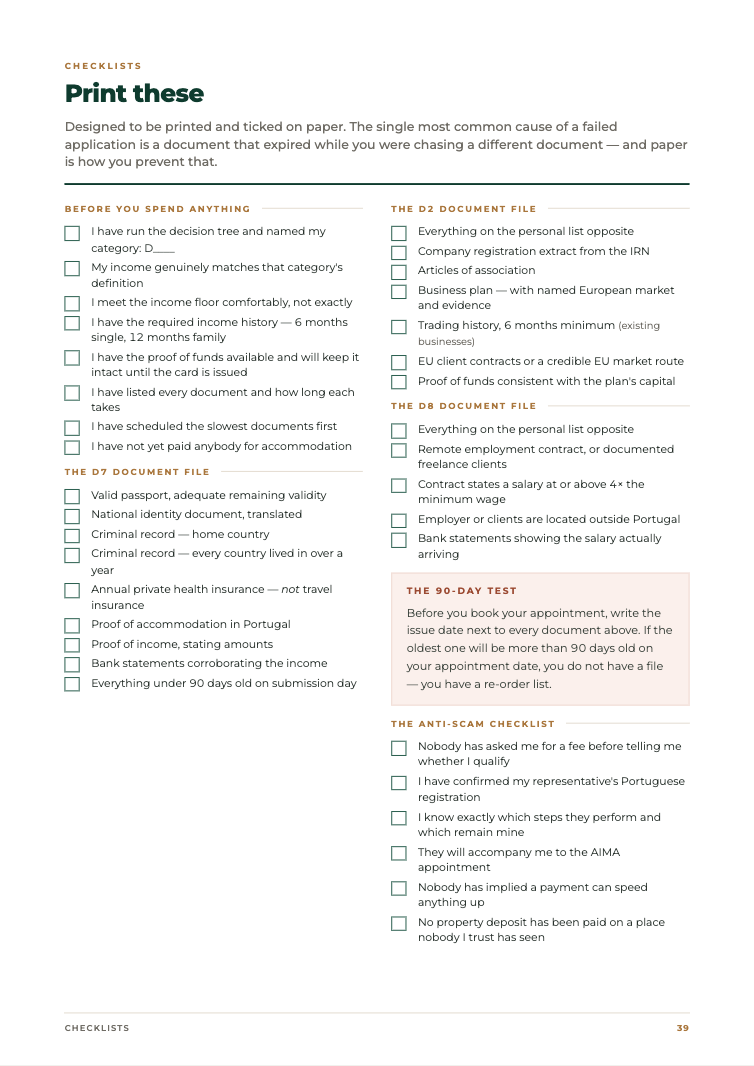
questions, and a set of checklists designed to be printed and ticked
off on paper.
There is no filler in it. I cut it until every page was one you would
actually use, because a manual you do not finish is worth nothing. It
is written for one outcome: that you file once, and the answer
is yes.
The whole move priced to within a few hundred euros
A document file sequenced so nothing expires
Every payment in the order that protects you
The seven refusal traps, recognised before you hit them
The full path through to permanent residency and citizenship
What to do if you have already been refused
Everything you get
All twenty-five chapters, in the order you need them
Eight parts, built to be worked through from front to back the first
time and used as reference forever after.
Part One
Decide
The route that is actually yours, settled before you spend anything.
01Why PortugalCompared honestly against Spain, Greece and Malta — including when Portugal is the wrong answer.
02The routes, in plain languageD7, D2, D8, plus the Golden Visa, Article 88 and family reunification, and why the others usually do not fit.
03The decision treeOne honest question sorts almost everybody. Worked profiles, plus the trap inside the tree.
04Seven expensive mythsStarting with the one that causes more refusals than anything else in Portuguese immigration.
Part Two
Qualify
The specification sheet for each route, with 2026 numbers.
05The D7 in fullEvery income type that counts as passive and every one people wrongly think does. Thresholds for a single applicant, a couple and each child.
06The D2 in fullNew company versus extending an existing business, what the reviewer is really testing, and the red flags that get plans refused.
07The D8, and when two routes are openWhy “I work remotely” is not a qualification — and which route to take when you qualify for both.
Part Three
Budget
Where the money actually goes, and the order to spend it in.
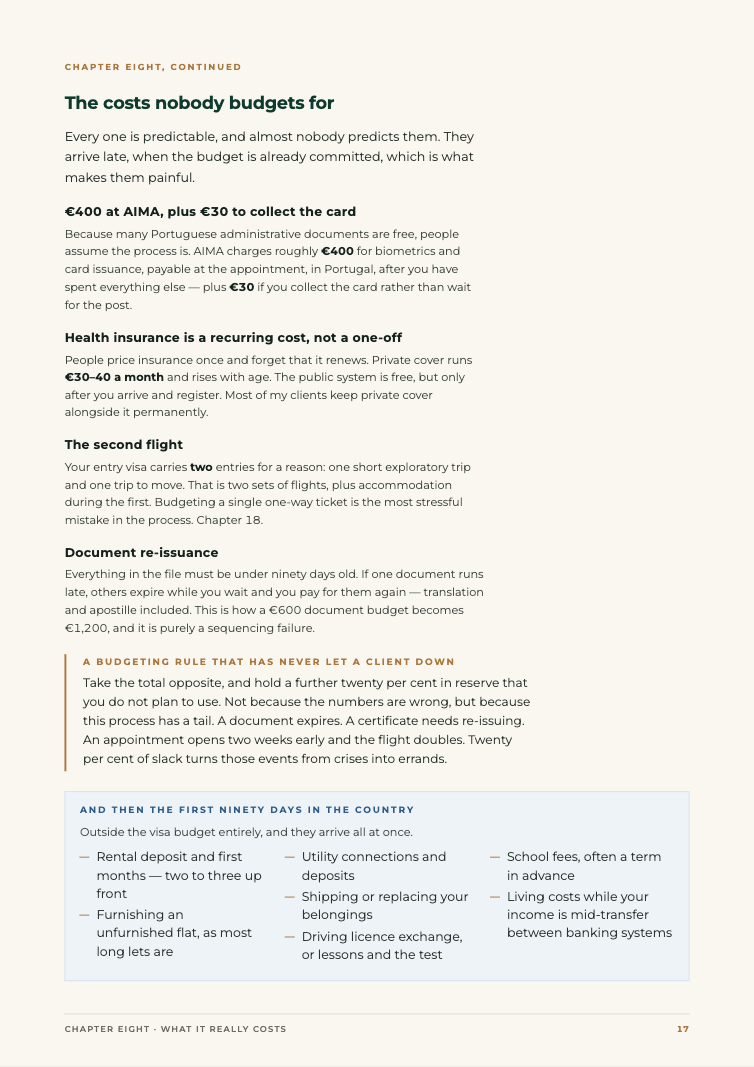
08What it really costsEvery line item with real ranges, the costs nobody budgets for, and a fully worked total for a single D7 applicant.
09Proof of funds, banks and the NIFHow much must be sitting there, whether it must be Portuguese, which banks open remotely, and the step that unblocks everything.
10The order you spend inThe shortest chapter in the book and the one that saves the most money. The first steps are nearly free.
11Tax, practicallyNHR is closed and IFICI replaced it. The annual filing rhythm, and why your tax records are an immigration document.
Part Four
Document
The complete dossiers, document by document.
12The D7 dossierWhat each document is, where to get it, whether it needs translating or apostilling, and what trips people up on each one.
13The D2 dossierThe same treatment for the business route, including everything the company side adds.
14Apostilles, translations and criminal recordsWhat an apostille actually is, real routes and costs, and the document order I use on every file.
15Health insurance that passesWhat qualifies, what it costs, which providers to use, and the free national system you cannot use yet.
Part Five
Execute
The whole process in order, narrated as if you started today.
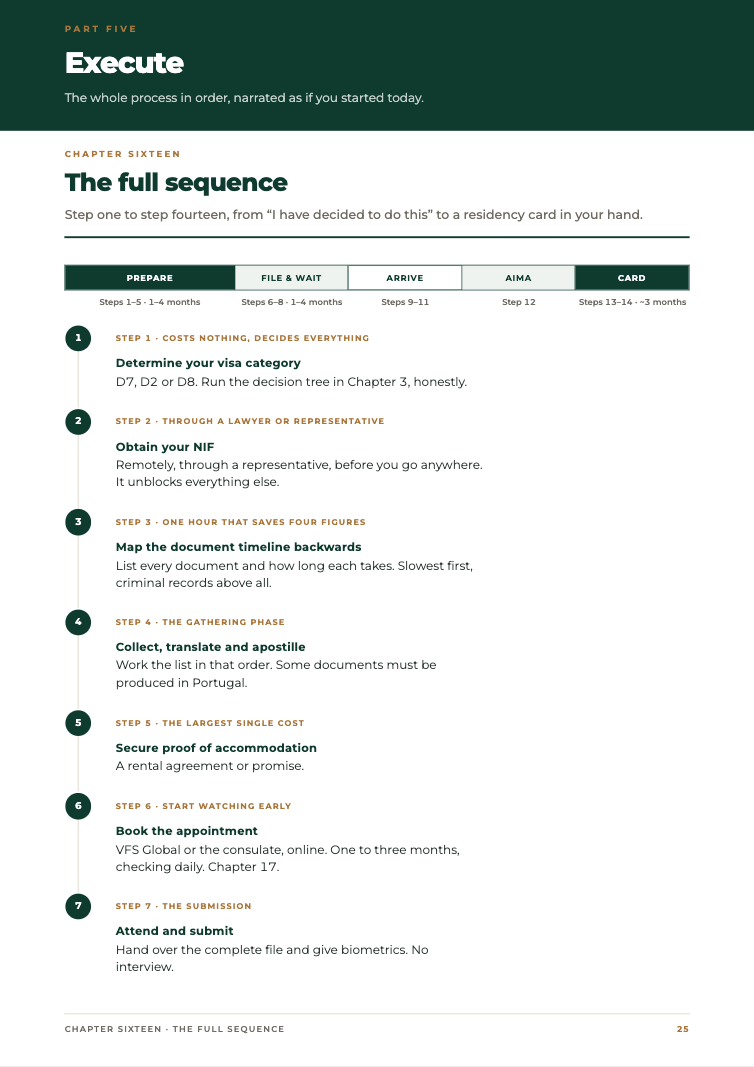
16The full sequenceFourteen numbered steps from “I have decided” to the card in your hand, with realistic timings on each.
17Who decides, and getting bookedVFS Global, the consulate and AIMA do different jobs. The realistic wait, the one tactic that finds a slot, and the only way to fail the appointment.
18The 120-day window, and landingWhy your visa carries two entries, the two-trip strategy, and everything from arrival to card.
Part Six
Protect
Refusals, recovery, and the people who sell to you.
19Why applications failThe seven real reasons in order of frequency, each with exactly how to clear it.
20Refused: what nowHow to read the letter, which grounds mean appeal and which mean rebuild, and the first week after a refusal.
21Scams and bad adviceThe single most reliable tell of a fraud in this market, four questions that end the conversation, and how to read a Facebook group safely.
Part Seven
Live
Keeping it, and what the next ten years look like.
22Keeping your residencyWhat the law says about absence, the number that actually governs your renewal, and what a renewal requires.
23Permanent residency and citizenshipThe 2026 change explained plainly, the A2 language requirement in proportion, and why year five matters more than year ten.
24Bringing your familyThe thresholds, the exception for young children, and the strategic choice between arriving together or sequentially.
25Actually living thereWhere people settle and what rent costs, how healthcare works in practice, licences, and what schools cost.
Part Eight
Reference
The part you will keep coming back to.
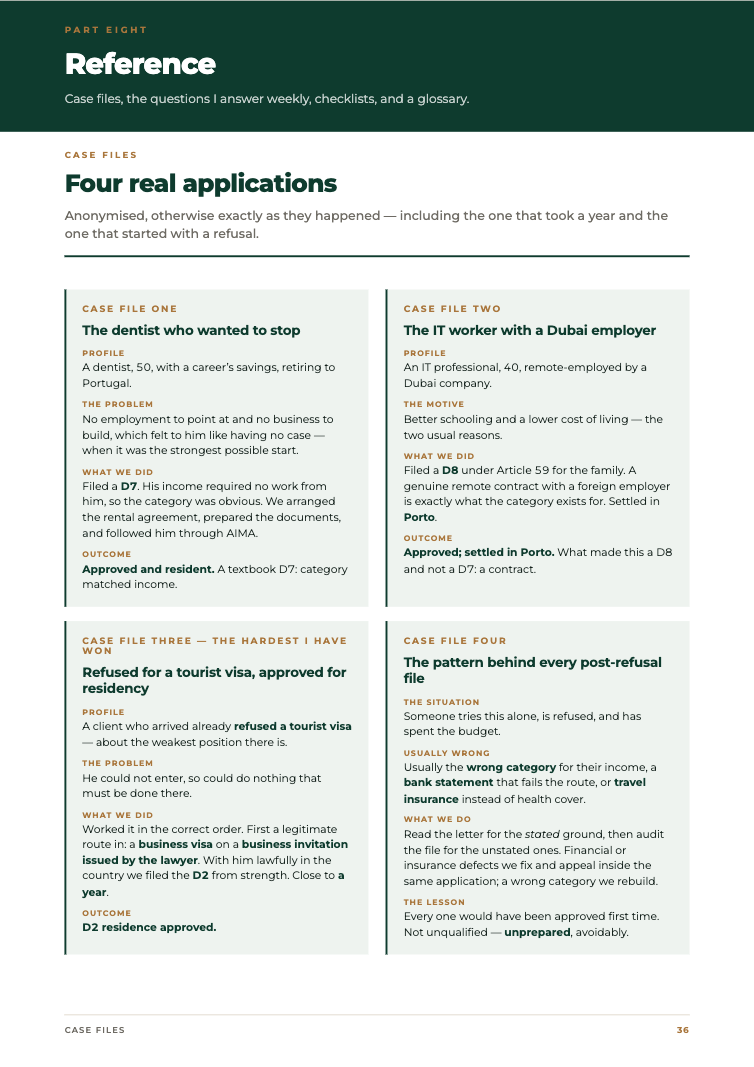
—Four case filesReal applications, anonymised, start to finish — including the tourist-visa refusal that became D2 residence.
—Thirty-three straight answersThe questions I am asked every single week, answered without hedging.
—Eight printable checklistsBefore you spend anything, each document file, the 90-day test, the anti-scam questions, before you fly, after you land.
—Budget worksheet and glossaryFill in your own numbers, and decode AIMA, NIF, IRS, IRN, SNS, IFICI and the article numbers on your paperwork.
Every page is laid out to be used — tables you can work from,
sequences you can follow, checklists you can tick.
Chapter 3 — The decision treeOne question sorts almost everybody, plus the trap inside it.
Chapter 8 — What it really costsEvery line item with real ranges, and a worked total.
Chapter 12 — The D7 dossierDocument by document: source, translation, apostille, pitfalls.
Chapter 16 — The full sequenceFourteen steps with realistic timings on each.
Part Eight — The case filesReal applications, including one that began as a refusal.
The master checklistsPrintable, and the reason documents stop expiring on you.
Chapter 25 — Actually living there
The same visa costs twice as much depending on where you point it
Accommodation is the largest and most variable line in the whole budget,
and nobody tells you that the city you pick moves it by thousands. One
real file: a single D7 applicant settling in Porto came to
€6,915 all-in. The identical application aimed at
Lisbon passes €10,000.
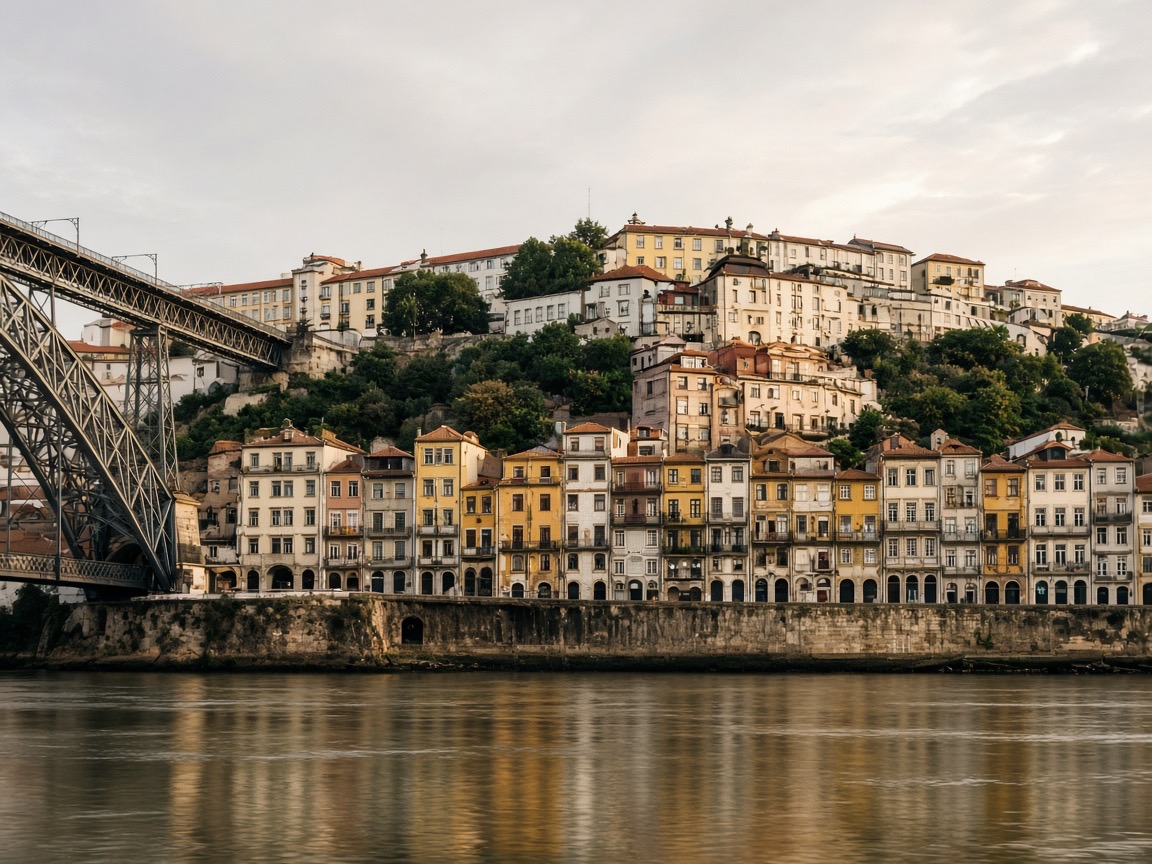
Porto & Braga
The affordable end · full services
Hospitals, international schools, airports and work — everything a
resident actually needs, at the bottom of the accommodation range. Most
people who move for cost of living end up in one of these two.
Lisbon
The expensive end · a different budget
The city almost everybody names first, and the one that pushes a
straightforward application past €10,000 before anyone has paid a
lawyer. Worth it to some people. Worth knowing in advance for everyone.
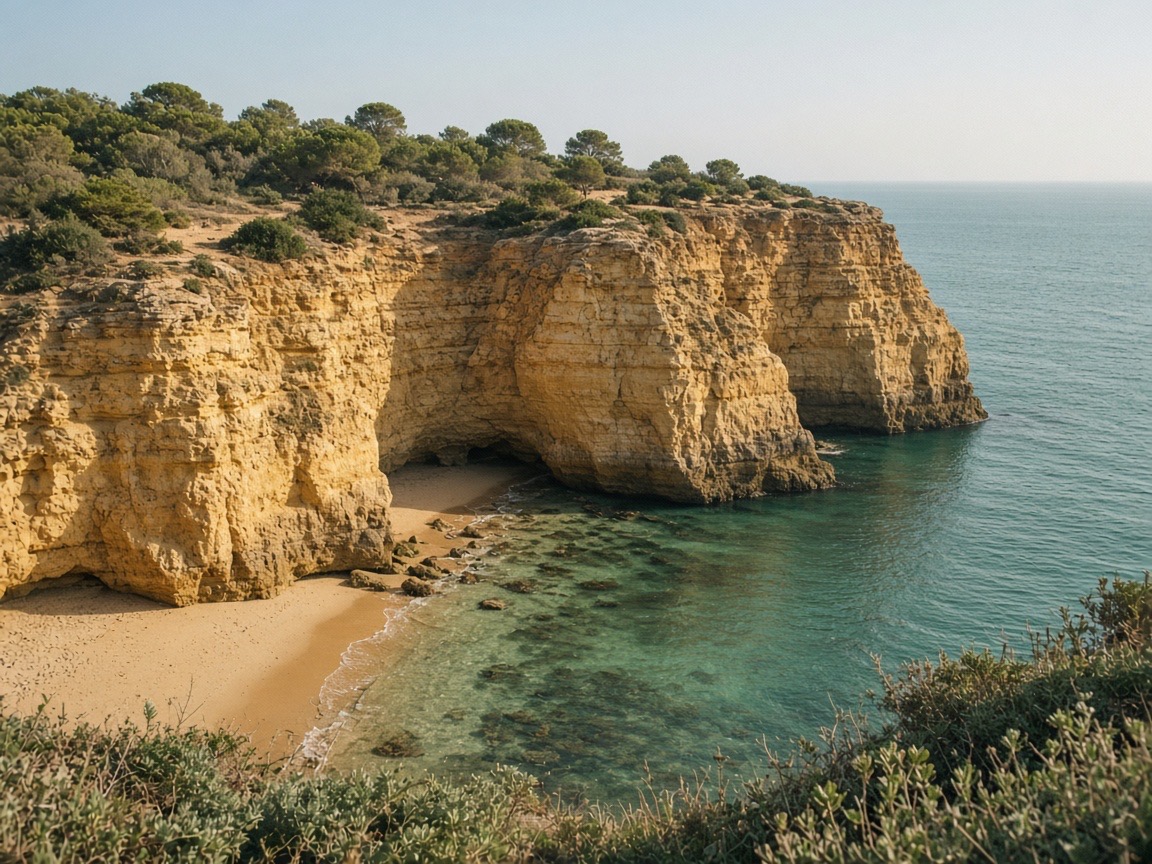
The Algarve
Expensive · and seasonal
The trap here is not the price, it is the calendar. The Algarve is
lively in August and closed in February, which catches out people who
visited once, in summer, and decided on the strength of it.
From the case files
The people whose applications became these pages
Anonymised at their request. Every one of them is a file I carried
personally, from the first conversation to the card in their hand.
“I had no job to point at and no business to build, and I was
convinced that meant I had no case. It turned out to be the
strongest possible starting position — I just did not know
which category I was in. Simon knew in the first conversation. The rest
was paperwork.”
DA dentist, 50Retired to Portugal
D7 · Approved and resident
“We moved for our child's education and a cost of living we could
actually breathe in. What I did not understand until it was explained
to me was that my employment contract was the entire
application — not my savings, not my CV. We are settled in
Porto now.”
ITAn IT professional, 40Remote employee of a Dubai company
D8 · Family of three, settled in Porto
“I had already been refused a tourist visa. I genuinely believed
the door was shut. It took almost a year, and we had to find a
legitimate way into the country before we could even begin — but
I hold D2 residence today.”
BA business ownerPreviously refused a tourist visa
D2 · The hardest case in the book
“I came to him after a refusal with my budget already spent. The
letter said one thing; the real problem was two others that
nobody had looked for. Reading it properly took him an afternoon. It
would have taken me another year.”
RA refused applicantRebuilt and refiled under the correct category
Refused once · approved on the rebuild
“The part I would never have guessed: they check everything
again, in Portugal, months later. I had been told the visa was
the finish line. Being walked through the AIMA appointment instead of
turning up alone was worth the whole engagement.”
CA couple in their sixtiesPension and rental income
D7 · Card issued, renewed once
“I had an apartment picked out and a deposit ready to send. He
told me to stop and do nothing until we knew which visa I was
filing. That one sentence saved me several thousand euros, because the
city I had chosen was wrong for me.”
FA freelancer, 34Relocated to Braga instead of Lisbon
D8 · Filed once, approved
“Every one of the people who comes to me after a refusal would
have been approved the first time. They were not unqualified. They were
unprepared, in a specific and entirely avoidable way. That is the whole
reason this book exists.”
Simon — from Part Eight, Case File Four
Who wrote this
I am an immigrant before I am an adviser.
I have held residence permits in five different countries across four
continents. Portugal is the fifth time I have done this to myself.
That is not a credential I put on a page to look interesting. It is the
reason I can write this book. Going through immigration systems
personally — five times, on four continents — taught me the
thing that actually transfers between jurisdictions: immigration
departments largely use the same techniques and follow the same
patterns. They are not arbitrary. They are pattern-matching machines,
looking for a specific shape of application, and when they get it, they
approve it.
For fifteen years I have handled other people's cases across three
jurisdictions, with a working knowledge of international and
immigration law. More than thirty cases taken through to approval. Not
a volume operation — files I carried personally, each one from
the first conversation to the card in the client's hand.
Almost every refusal I have ever read was avoidable at the preparation
stage, for free. This book is the preparation stage, written down.
5Countries I have personally held residence permits in, across four continents
15Years handling immigration casework across three jurisdictions
30+Cases carried personally from first conversation to residency card
5thTime going through this process myself — currently, in Portugal
Story three
Every file I am handed after a refusal has the same shape, and I can usually name the problem before I open it.
Someone attempts this alone. They are refused. They arrive at my desk
holding a refusal letter and a budget that has already been spent.
That is the pattern. It is so consistent that it has its own case file in
Part Eight, because it is not really one client's story — it is the
story of most of the people who hire me.
And when I audit those files, the problem is almost always one of three
things, usually the first: the wrong visa category for
their actual income, a bank statement that does not
support the route they chose, or travel insurance where
annual health insurance was required.
Three problems. All three cost nothing to avoid, and all three are decided
at the kitchen table months before anybody submits anything.
They were not unqualified. They were unprepared — in a specific, nameable and entirely avoidable way.
The one sentence this whole book exists to prevent
So here is my problem, professionally. I can read a refusal letter for its
stated ground, audit the file for the unstated ones, fix the financial and
insurance defects inside the same application, or rebuild and resubmit
where the category itself was wrong. That is what the engagement is. People
pay for it and it is worth what they pay.
But it is repair work. It is slower, more expensive and more stressful than
the alternative, and the alternative was free. The alternative was knowing,
in advance, which of the seven traps was in front of them.
I could not keep having that conversation one person at a time. So I wrote
down the whole preparation stage — every threshold, every document,
every cost, every sequence, every trap — and I priced it at
twenty-seven dollars so that nobody has to hire me to find out which
article of Portuguese law their income falls under.
That is what the Blueprint is. It is the conversation I
have with a client in the first week, in full, before the mistakes are
made.
Honest qualification
This is not for everyone, and I would rather say so now
I would rather you did not buy it than buy it and find it was not
written for you.
Get this if
You have decided to move to Portugal, or you are close, and you want the real mechanics rather than more inspiration.
Your income comes from a pension, property, dividends, shares, royalties, a remote job, freelance clients, or a business you own.
You are tired of forum answers that contradict each other and want one coherent account from somebody who files these.
You intend to do some or all of this yourself, and you want to know exactly which steps you can handle and which you cannot.
You have already been refused and need to understand what actually went wrong before you spend money again.
You are relocating a family and need the thresholds, the reunification rules and the strategic choice between them.
Skip this if
You want somebody to promise you a guaranteed approval. Nobody can guarantee the decision of a sovereign consulate, and anyone who does is lying to you about more than that.
You are hoping for a loophole, a shortcut, or a way to make a category fit income it was not written for. This book will tell you the opposite.
You need a Portuguese passport quickly. From 2026 that is a ten-year horizon for most nationalities, and I will not pretend otherwise.
You are only daydreaming. This is a working manual with tables, deadlines and checklists — it is not a book about the light in Lisbon.
You want bespoke legal advice on your personal situation. That is a different service, and the book tells you plainly where that line falls.
The offer
Twenty-seven dollars, against a process that starts at €6,000
That is not a sales line, it is a figure from Chapter 8. A Portuguese
residency, done properly, A to Z, starts around €6,000 all-in. The
cheapest part of it is knowing what you are doing.
2026 Edition · Instant PDF
The Portugal Residency Blueprint
41 pages · 8 parts · 25 chapters, in working order
Read front to back once, then used as reference for yearsIncluded
The complete D7, D2 and D8 specifications
2026 thresholds with the formulas behind them, so they stay correct as the amounts driftIncluded
Full document dossiers for every route
Document by document: source, translation, apostille, and the pitfall on each oneIncluded
The fourteen-step execution sequence
With realistic timings, so you know what is normal and what is going wrongIncluded
The seven refusal traps, and how to clear each one
Plus what to do if you have already been refusedIncluded
Four anonymised case files from live practice
Including the tourist-visa refusal that became D2 residenceIncluded
Thirty-three answered questions
The ones I am asked every week, answered without hedgingIncluded
Eight printable checklists, a budget worksheet and a glossary
AIMA, NIF, IRS, IRN, SNS, IFICI, Article 59, Article 88 — decodedIncluded
One wrong-category refusal, avoided€4,000+
Your price today$27One payment · instant download · yours to keep
Instant PDF deliveryRead on any deviceUpdated for 2026
My guarantee, in plain language
Read it. If you get to the end and it has not told you something that
changes what you were about to do — your category, your sequence,
your budget, your insurance — then it has failed at the one job I
wrote it for, and I do not want your twenty-seven dollars.
Email me within 30 days and I will refund you in full.
You keep the book; I would rather you had the information than the
money. No forms, no explanation required.
Before you buy
Straight answers
Is this relevant if I am not sure which visa I need yet?
That is precisely who it is for. Chapter 3 is a single decision tree that
settles the question with one honest answer, plus worked profiles to
match yourself against. Choosing the wrong category is the single most
common cause of refusal, and it is the first thing the book removes.
I am American / British / Canadian / elsewhere. Does it apply to me?
Yes. The thresholds, document requirements, process and timelines are set
by Portugal and apply regardless of where you are coming from. What
changes by country is your apostille route and which office
issues your criminal record certificate — and Chapter 14 covers
the UK specifically and the general EU and international pattern, with
the questions to ask for your own country.
Will this be out of date in six months?
This is the 2026 edition and it is built for the 2026 rules —
including the two changes most online material has not caught up with:
the citizenship clock moving from five years to ten, and NHR closing in
favour of IFICI. More importantly, where Portugal pegs a threshold to
the national minimum wage, the book gives you
the formula as well as the euro figure. The formulas
stay correct even after the amounts drift.
Is this legal advice?
No, and it says so clearly on page two. It is a detailed account of how
the Portuguese residency system works in practice. Your nationality,
income structure, family composition and immigration history all change
what applies to you — and wherever a decision carries real
financial or legal consequence, the text says so and tells you to have
it checked.
I have already been refused. Is it too late for this to help?
No. Chapter 20 is written for exactly your situation: how to read the
refusal letter, which grounds mean you can fix the defect and appeal
within the same application, and which mean rebuilding and resubmitting
properly. Portugal provides a reason for refusal precisely because the
reason can usually be addressed. The hardest case in the book started
with a refused tourist visa and ended in D2 residence.
How much money do I actually need to have?
Two separate numbers, and conflating them is a common and expensive
mistake. There is the income floor you must demonstrate, which
for a single D7 applicant in 2026 is €920 a month, rising by 50%
for a spouse and 30% for each child. And there is the
savings reserve — roughly twelve months of that income,
held consistently, and still intact when AIMA looks at your statements
again inside Portugal. Chapters 8 and 9 give both, with the formulas.
Can I do this without a lawyer?
Partly. Some steps can only be performed inside Portugal by somebody
physically there, and the tax number in particular cannot be obtained
remotely without a lawyer or authorised representative. The book is
explicit about which steps are genuinely yours to do and which are not,
so you can decide where to spend and where not to — rather than
paying for the whole thing by default or discovering the limit halfway
through.
How long does the whole process take?
Six months to a year, start to finish, is realistic. The variables are
how fast you find an appointment, how long your documents take to
assemble, and how loaded AIMA is. Only the second is genuinely within
your control, which is exactly why the document sequencing chapter
exists.
Can I just hire you instead of reading a book?
You can, and many people do — the closing pages explain exactly
what that involves and how to reach me. But read this first anyway.
Clients who understand their own file make better decisions, ask better
questions, and spend less. And initial guidance on whether you qualify
costs nothing; real Portuguese lawyers do not charge for that, and
Chapter 21 explains why anyone who does is a warning sign.
Does it cover bringing my family?
Yes, as its own chapter. Reunification is available on every Portuguese
residence permit — spouse, minor children, dependent adult
children and dependent parents. What the chapter actually resolves is
the strategic question: arrive together, which means proving a higher
threshold up front, or go first and bring them after, which means a
lower threshold and a period apart. The maths on both is there.
What format is it, and how fast do I get it?
A single PDF, 41 pages, laid out in A4 and designed to be read on a
screen or printed. Delivery is immediate — you are taken straight
to a download page after checkout and the link is emailed to you as
well. The checklists near the back are specifically designed to be
printed and ticked off on paper.
Why is it only $27?
Because the information is cheap and not having it is not. I would
rather a hundred people file correctly than ten people pay me for a
consultation to be told which article of law their income fits under.
The people who need a file carried will find their way to me regardless;
the rest should simply have the manual.
One decision left
You are going to learn all of this eventually. The only question is what it costs you.
Either twenty-seven dollars and an evening — or a refused
application, a deposit on the wrong apartment, a stack of expired
certificates, and most of a year back at the beginning.
P.S. If you take only one thing from
this page, take this: the question that decides your whole application is
not how much you earn, how old you are, or where you are from. It is
whether producing your income requires you to work for it. Answer
that honestly and most of your risk disappears before you spend a single
cent. That answer is in Chapter 3, and the other twenty-four chapters are
what to do once you have it.
P.P.S. The dentist in the first story
is a client of mine. He holds D7 residence and he lives in Portugal. The
only thing that was ever wrong with his application was the order he did
it in — which is the entire contents of this book, and it costs less
than the taxi to the appointment.
The Portugal Residency Blueprint — 2026 Edition
41 pages · D7, D2 & D8 · instant download